
Reading Between the Lines: A Community Guide to the Texas SBOE's Proposed Reading List (Grades K–4)
Intended as a resource for public engagement, this guide highlights recurring themes, concerns, and questions Texans may consider when drafting public comment and contacting SBOE representatives

The Texas State Board of Education will vote next week (June 22–26) on a proposed state-mandated reading list spanning Kindergarten through English IV. The final list adopted by the board will become part of the Texas Essential Knowledge and Skills (TEKS), making these works required components of the state curriculum. The selections reveal recurring themes, repeated source materials, and broader patterns that offer insight into how some members of the board believe history, religion, character, citizenship, and American identity should be taught to Texas children.
This series is intended to help keep Texans informed about the work of the SBOE and provide parents, educators, librarians, faith leaders, and community members with information they can use when deciding whether to submit public comment or contact their elected board members.
The purpose of this article is not to tell readers what they should think about the proposed list. Rather, it is to identify recurring themes, highlight notable strengths, examine potential concerns, and raise questions Texans may wish to consider as they review the proposal for themselves. Readers will notice several recurring patterns, including the repeated use of anthologies compiled by politically influential figures, the continued reliance on source materials first published nearly a century ago, and the significant presence of biblical narratives and Christian-themed selections throughout the K–12 sequence.
Taken individually, many of these selections may appear unremarkable. Viewed together, however, they reveal a broader vision for what Texas students should read and which stories, values, historical figures, and cultural traditions should be elevated as foundational.
This is Part One and covers Kindergarten through Grade 4. Future installments will examine Grades 5–8 and Grades 9–12, where questions surrounding religious influence, historical framing, ideological balance, and the overall direction of the proposed list become even more pronounced.
Kindergarten
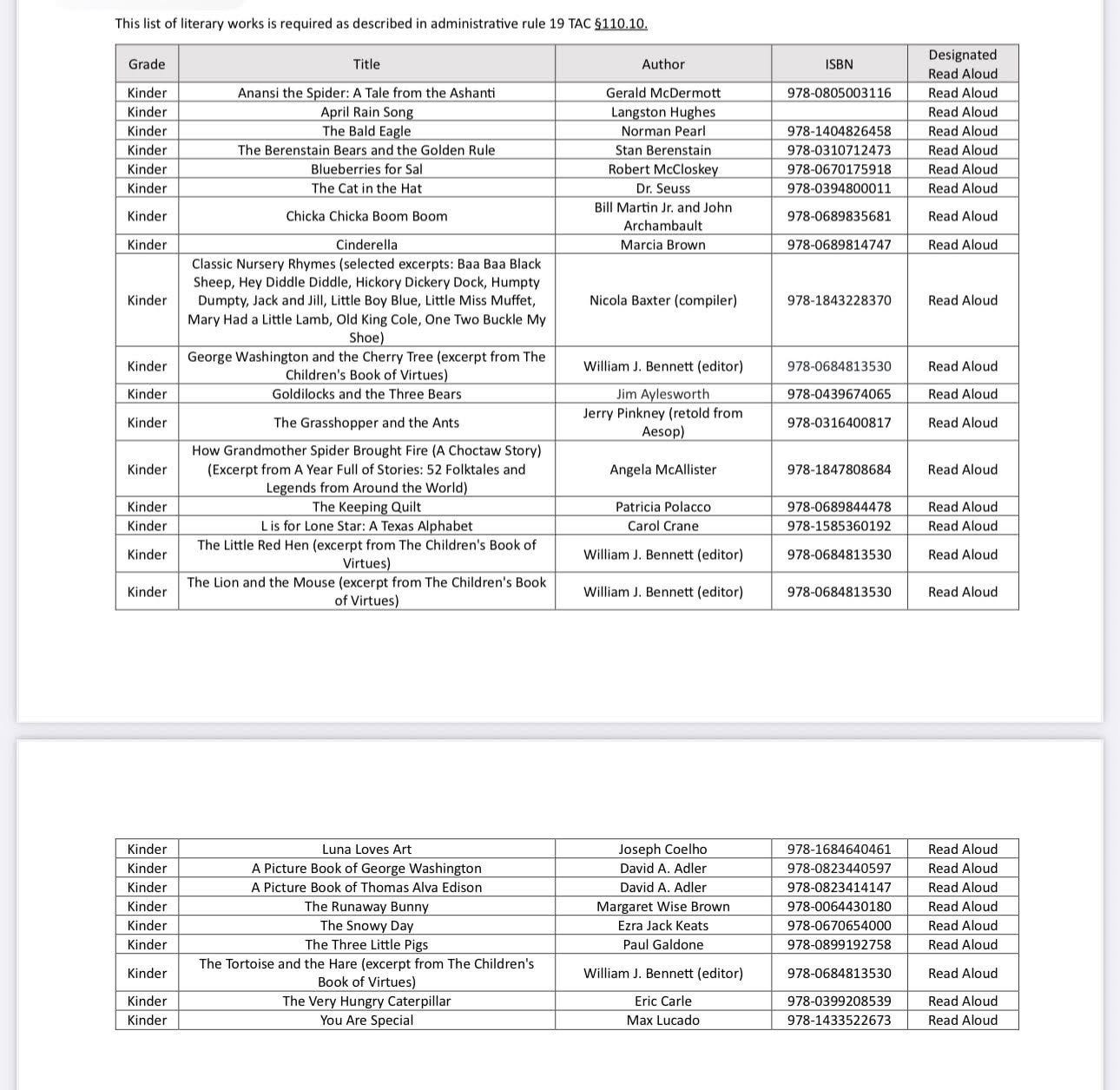
Overall Themes
Kindergarten introduces students to nursery rhymes, fairy tales, folktales, fables, poetry, character education stories, and early biographies. Students encounter classic works such as Cinderella, Goldilocks and the Three Bears, The Little Red Hen, The Snowy Day, Anansi the Spider, How Grandmother Spider Brought Fire, and Langston Hughes’ April Rain Song. The list seeks to establish foundational literacy while introducing students to stories that shape cultural knowledge, moral lessons, and early understandings of American history.
Major Concern: Reliance on The Children’s Book of Virtues
Several selections are drawn from The Children’s Book of Virtues by William J. Bennett. Unlike most of the other books on the list, this is not simply a collection of children’s literature but an anthology intentionally assembled around a particular philosophy of moral education and character formation.
William Bennett is a philosopher, conservative political commentator, former chair of the National Endowment for the Humanities, former U.S. Secretary of Education under Ronald Reagan, and later the nation’s first “drug czar” under George H. W. Bush. During the 1980s and 1990s, Bennett became one of the most prominent voices in the conservative culture wars, arguing that America was experiencing a decline in moral values and that schools and families should place renewed emphasis on traditional character education.
The Children’s Book of Virtues grew out of Bennett’s bestselling The Book of Virtues and was explicitly designed to teach moral character through literature. The anthology organizes stories, poems, myths, fables, historical anecdotes, and religious passages around virtues such as courage, honesty, responsibility, loyalty, friendship, compassion, perseverance, self-discipline, faith, and hard work.
The concern is not that children should learn virtues such as honesty, courage, kindness, or responsibility. Few would disagree with those goals. The question is whether a state-mandated literary list should repeatedly rely on an anthology assembled by a political figure who openly viewed the collection as part of a broader effort to address what he saw as America’s moral and cultural decline.
Because the anthology is organized around a specific worldview, Texans may reasonably ask whether other approaches to teaching character, citizenship, empathy, and community were considered.
Major Concern: Representation and Cultural Perspective
The list includes several welcome examples of cultural diversity, including Ashanti folklore, a Choctaw traditional story, works by Langston Hughes, and Ezra Jack Keats’ The Snowy Day. However, these selections exist within a collection still dominated by traditional European fairy tales, nursery rhymes, and stories rooted in Western cultural traditions.
Because Kindergarten often provides a child’s first sustained exposure to literature in school, Texans may wish to ask whether the earliest literary experiences of Texas students adequately reflect the diversity of modern Texas classrooms.
Strengths
The Kindergarten list contains many enduring classics that have introduced generations of children to literature. The Snowy Day, Anansi the Spider, How Grandmother Spider Brought Fire, and Langston Hughes’ poetry expose students to a variety of cultural traditions and literary forms.
Questions for SBOE Members
Why are multiple selections drawn from The Children’s Book of Virtues?
What criteria were used to determine which stories from that anthology were selected?
Were more contemporary children’s classics considered?
How were Indigenous, multicultural, and international stories selected?
Does the overall collection reflect the diversity of today’s Texas students?
Grade 1
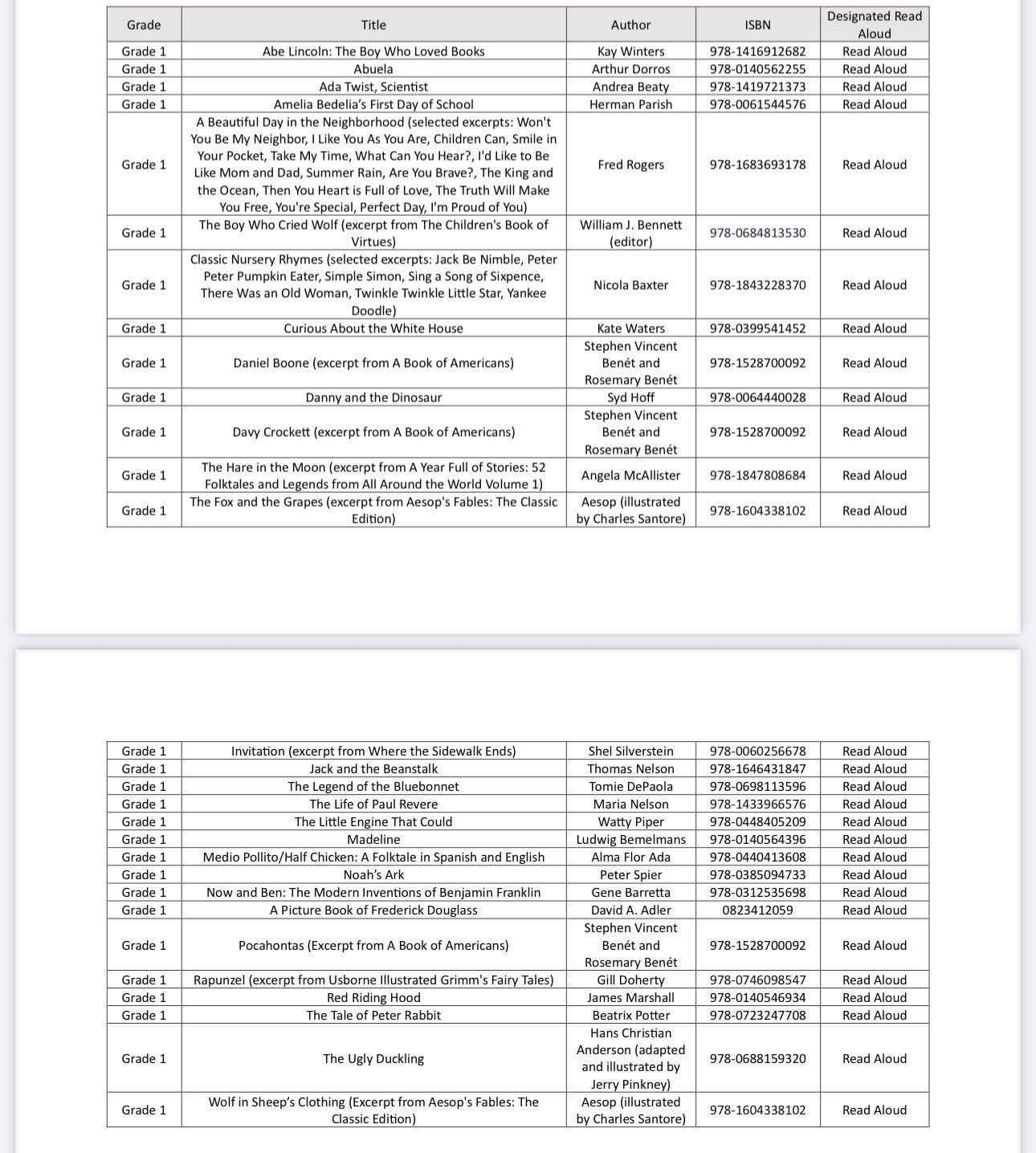
Overall Themes
Grade 1 includes folk tales, nursery rhymes, biographies, fairy tales, Noah’s Ark, Pocahontas, Frederick Douglass, Paul Revere, Benjamin Franklin, Daniel Boone, Davy Crockett, Abraham Lincoln, and several classic children’s stories. The list introduces students to American historical figures, civic heroes, frontier legends, and foundational cultural narratives while continuing the emphasis on traditional literature established in Kindergarten.
Major Concern: Pocahontas and A Book of Americans
The list includes Pocahontas (Excerpt from A Book of Americans) by Stephen Vincent Benét and Rosemary Benét. This excerpt comes from a book first published in 1933 and is one of several selections drawn from the same source.
The poem portrays Pocahontas as a “wild thing tamed,” emphasizes her admiration for English settlers, and omits important historical facts such as her kidnapping by English colonists. Critics have argued that the book reflects outdated views of Native peoples and presents colonization through a romanticized lens rather than through the historical understanding available today.
The same source is also used for biographies of George Washington, Thomas Jefferson, Abraham Lincoln, Daniel Boone, and Davy Crockett elsewhere on the proposed list.
The concern is not whether students should learn about Pocahontas. The concern is why Texas chose a poem first published in 1933 when numerous modern biographies and historically informed children’s books are available.
Major Concern: Frontier Mythology and Historical Selection
Grade 1 places significant emphasis on frontier figures and early American heroes, including Daniel Boone, Davy Crockett, Paul Revere, Benjamin Franklin, Abraham Lincoln, and Frederick Douglass.
Particularly noteworthy is the inclusion of Daniel Boone and Davy Crockett, two figures whose historical significance is often intertwined with folklore, frontier mythology, and westward expansion. Texans may wish to ask what educational objectives their inclusion serves and how decisions were made regarding which figures are considered foundational for all first-grade students.
Major Concern: Noah’s Ark
The inclusion of Noah’s Ark raises questions about the repeated use of biblical texts throughout the K–12 sequence. While often remembered as a children’s story about animals and a great flood, the biblical narrative centers on God destroying nearly all life on Earth in an act of divine judgment.
The inclusion of Noah’s Ark becomes more significant when viewed alongside biblical selections that appear in later grades, including Luke, Matthew, Psalms, Ecclesiastes, Lamentations, Genesis, Job, and Corinthians.
Strengths
The grade level contains several strong selections, including A Picture Book of Frederick Douglass, Abuela, and Ada Twist, Scientist, which broaden representation and expose students to diverse experiences and aspirations.
Questions for SBOE Members
Why was a 1933 source selected for Pocahontas and several other historical figures?
Were modern biographies and Indigenous-authored retellings considered?
Why were Daniel Boone and Davy Crockett selected as required biographies?
How were religious texts selected for inclusion, and what consideration was given to balance among religious, cultural, and literary traditions?
Grade 2
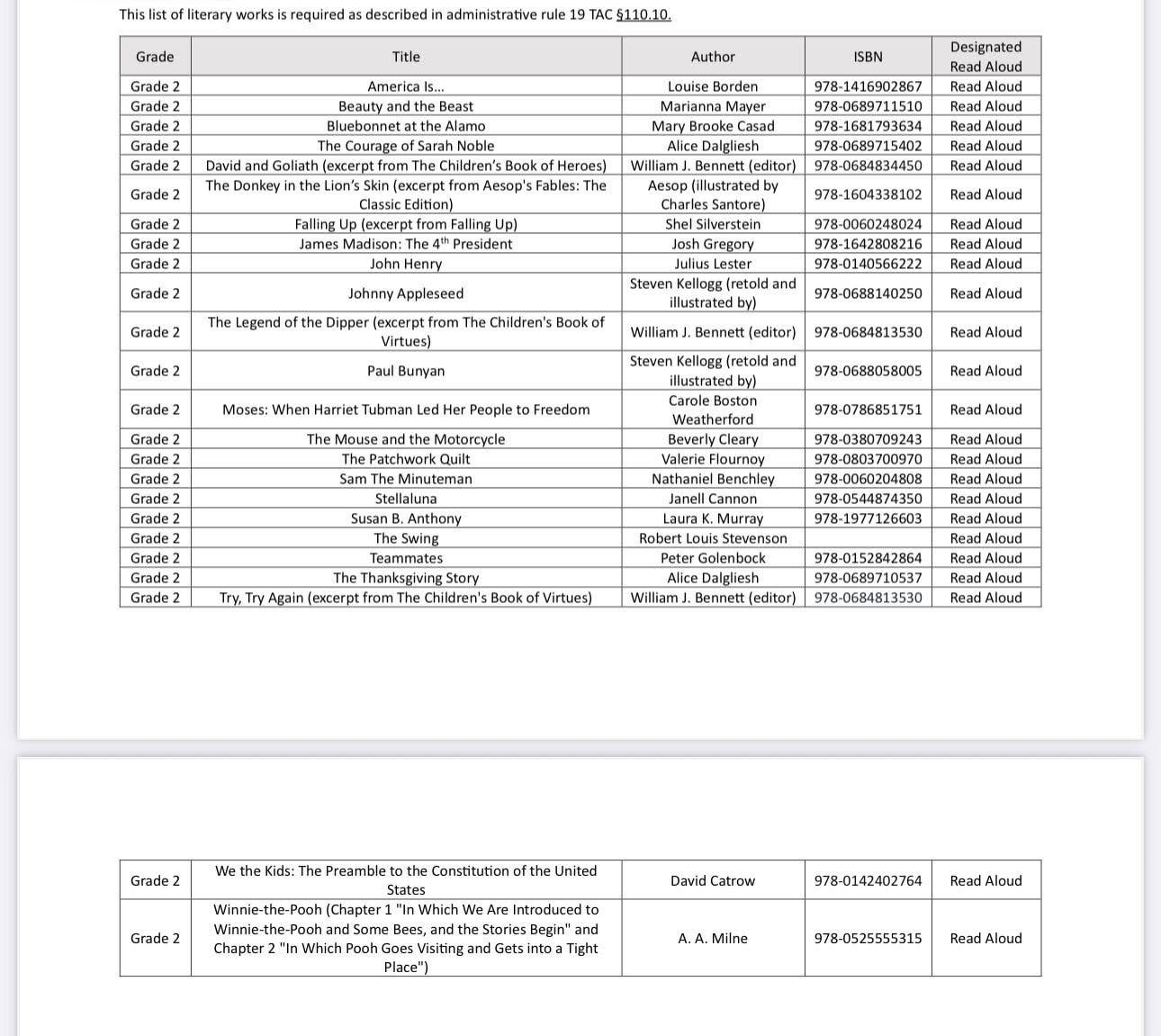
Overall Themes
Grade 2 continues the emphasis on American history, civic heroes, folklore, fables, and character-building stories. Students encounter Harriet Tubman, Susan B. Anthony, Benjamin Franklin, James Madison, John Henry, Paul Bunyan, Johnny Appleseed, and selections connected to the Constitution and the founding of the United States.
Major Concern: William Bennett’s Definition of Heroism
Grade 2 includes David and Goliath from William J. Bennett’s The Children’s Book of Heroes. While distinct from The Children’s Book of Virtues, the anthology reflects the same author’s philosophy of moral and civic education.
The question is not whether children should learn about heroes. The question is why Texas repeatedly relies on anthologies compiled by a single political figure to define both virtue and heroism for elementary students.
Major Concern: The Courage of Sarah Noble
Published in 1954, The Courage of Sarah Noble has been criticized by Native American literature scholars for its portrayal of Indigenous people through a colonial lens. Critics argue that the story frames Native communities as objects of fear that Sarah must learn to overcome while providing little Indigenous perspective of their own.
Supporters view the book as a product of its time and a story about friendship across cultures. Community members may wish to ask whether a text that has generated decades of discussion about stereotypes and cultural authenticity remains the strongest available choice when contemporary Indigenous-authored children’s literature is widely available.
Strengths
The inclusion of Harriet Tubman and Susan B. Anthony broadens the range of historical voices represented on the list and is a notable strength.
Questions for SBOE Members
How were historical figures selected for inclusion?
Why does William Bennett’s work continue to appear in the elementary grades?
Were additional Indigenous perspectives considered?
How were folklore, legend, and historical biography balanced?
Grade 3
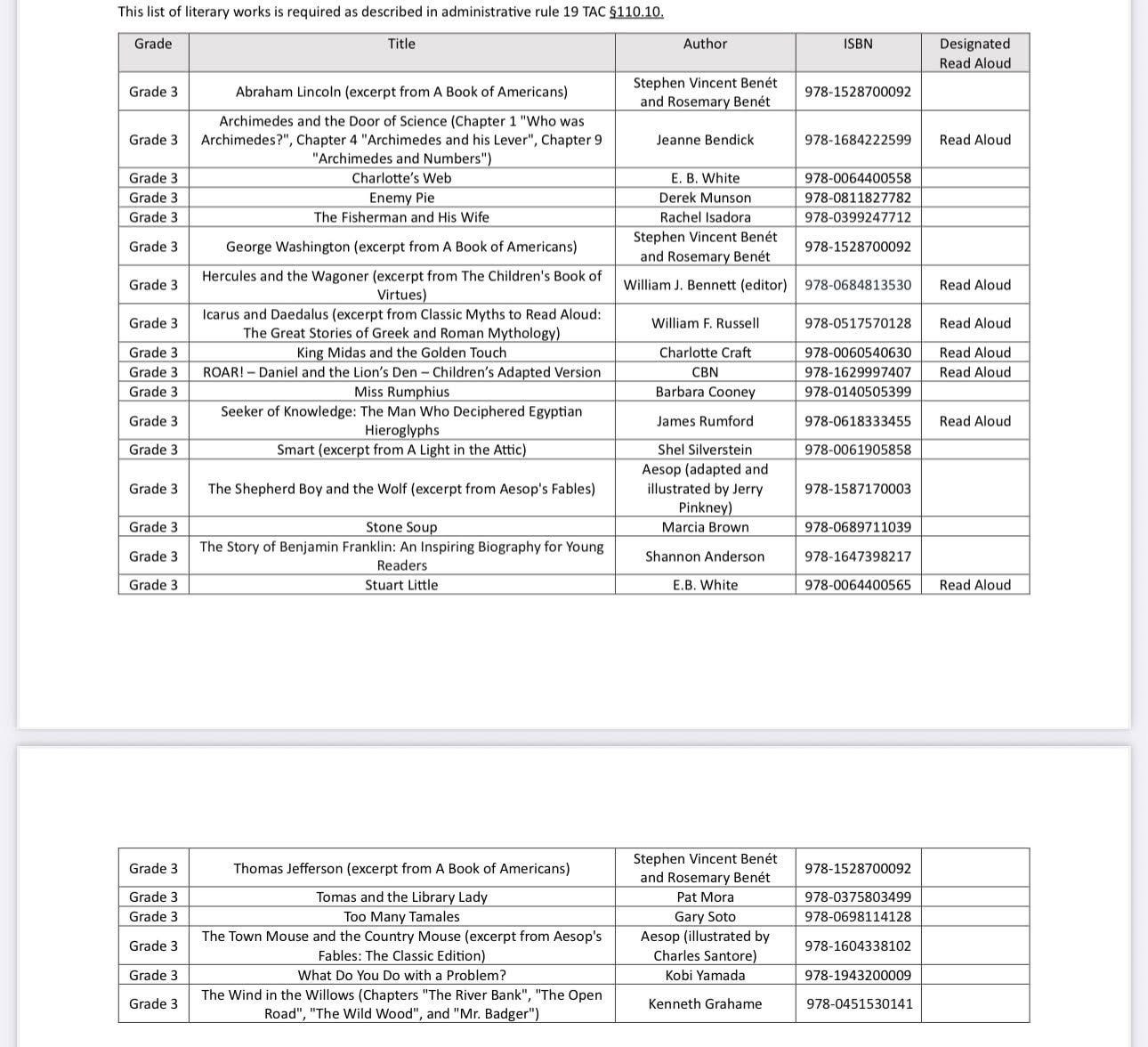
Overall Themes
Grade 3 introduces students to mythology, folklore, biographies, scientific discovery, innovation, and foundational figures in American history. Students encounter George Washington, Thomas Jefferson, Abraham Lincoln, Thomas Edison, George Washington Carver, Leonardo da Vinci, Greek mythology, and literary works such as Tomás and the Library Lady and Too Many Tamales.
Major Concern: Continued Reliance on A Book of Americans
Grade 3 continues the board’s reliance on A Book of Americans, first published in 1933. Students encounter George Washington and Thomas Jefferson through the same source previously used for Pocahontas, Abraham Lincoln, Daniel Boone, and Davy Crockett.
The concern is not whether students should learn about these figures. The concern is why Texas continues to rely on a source written before the Civil Rights Movement, before modern Indigenous scholarship, and before many of the historical developments that reshaped how Americans understand their history.
Major Concern: Continued Reliance on William Bennett Anthologies
Grade 3 also continues the board’s reliance on The Children’s Book of Virtues. By this point, students may have already encountered selections from Bennett’s anthologies in Kindergarten and Grade 2.
Taken together, the repeated appearance of Bennett's anthologies and A Book of Americans raises a broader question: why are a handful of editors and curated collections exercising such outsized influence over the elementary literary experience of Texas students? William Bennett was not a politically neutral figure but a leading conservative voice in the culture wars of the 1980s and 1990s who explicitly viewed his anthologies as tools for moral and character formation. Texans may reasonably ask whether other educational philosophies and literary perspectives received comparable consideration.
Major Concern: Representation of Women
One of the most striking features of the Grade 3 list is that nearly all of the major historical figures students study are men. Students encounter founders, inventors, scientists, artists, and cultural heroes, but the overwhelming majority of those figures are male.
The concern is not that these men are unworthy of study. The question is whether a grade level focused on leadership, innovation, science, invention, and creativity should also introduce students to women who made significant contributions in those same fields.
Strengths
Tomás and the Library Lady, Too Many Tamales, and George Washington Carver broaden representation and provide perspectives often missing from traditional elementary reading lists.
Questions for SBOE Members
Why does A Book of Americans continue to appear across multiple grade levels?
Why do William Bennett anthologies continue to appear across multiple elementary grades?
Why are the vast majority of historical figures in Grade 3 male?
What balance was sought between Western traditions and other world cultures?
Grade 4
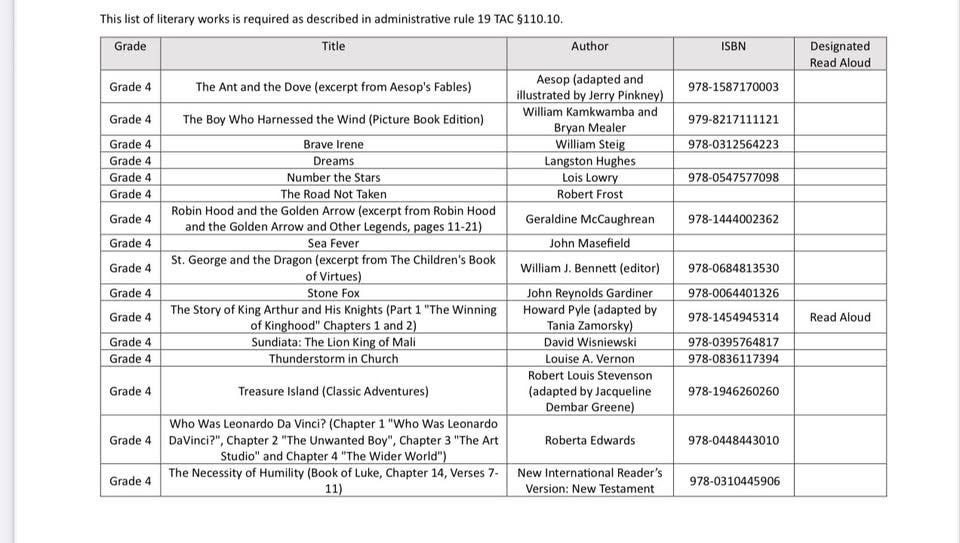
Overall Themes
Grade 4 focuses on leadership, exploration, invention, perseverance, heroism, and the development of Western civilization. Students encounter Number the Stars, The Boy Who Harnessed the Wind, Leonardo da Vinci, King Arthur, Robin Hood, St. George and the Dragon, and selections from the Gospel of Luke.
Major Concern: Continued Reliance on William Bennett Anthologies
Grade 4 continues the board’s repeated reliance on William J. Bennett’s anthologies through selections such as Robin Hood and the Golden Arrow and St. George and the Dragon from The Children’s Book of Virtues. By this point, students may have encountered Bennett’s work in Kindergarten, Grade 2, Grade 3, and now Grade 4.
The concern is not that stories about courage, virtue, or perseverance are inappropriate for children. The question is why a state-mandated literary list repeatedly relies on anthologies curated by a single political figure to define virtue, heroism, and character across multiple grade levels.
Major Concern: Religious Texts and Protestant Narratives
Grade 4 includes The Necessity of Humility from the Gospel of Luke. The proposed list specifies the New International Reader’s Version (NIrV), a children’s translation derived from the evangelical Protestant New International Version.
The concern is not that students learn about the Bible as an influential text. The Bible has undeniable literary and historical significance. The question is why a specifically evangelical Protestant translation was selected and whether comparable texts from other religious traditions were considered.
Major Concern: Representation of Women
Although Grade 4 contains strong female characters within works such as Number the Stars, the list continues a broader pattern in which historical figures, inventors, leaders, explorers, and cultural heroes are overwhelmingly male.
Strengths
Number the Stars and The Boy Who Harnessed the Wind are among the strongest selections in the elementary grades. They broaden students’ understanding of both history and human experience while introducing perspectives beyond traditional American and European narratives.
Questions for SBOE Members
Why do William Bennett’s anthologies continue to appear across multiple elementary grade levels?
Why was the NIrV selected for biblical passages?
Were texts from other religious traditions considered?
How was balance between Western traditions and other world cultures evaluated?
Why are historical leaders, inventors, and heroes so overwhelmingly male throughout the elementary grades?
In Part Two, I will examine Grades 5–8, where questions about religious texts, American exceptionalism, historical framing, and ideological balance become even more pronounced.
In Part Three, I will examine the high school list, including Margaret Thatcher’s eulogy for Ronald Reagan, Ayn Rand’s defense of capitalism, Thomas Sowell’s political commentary, biblical selections, and broader questions about ideological balance in a state-mandated curriculum.
The SBOE’s final vote is scheduled for next week. Texans who wish to provide input may submit public comment or contact their elected SBOE members before the vote. The more informed the public is about these decisions, the better equipped we are to have meaningful conversations about what Texas students should be reading.
The SBOE’s final vote is scheduled for next week. Texans who wish to provide input may submit public comment or contact their elected SBOE members before the vote. The more informed the public is about these decisions, the better equipped we are to have meaningful conversations about what Texas students should be reading.
I will be in Austin next week to provide public testimony and continue monitoring these discussions as both an educator and a candidate for the State Board of Education. If you find this work valuable and would like to support continued efforts to keep Texans informed about SBOE actions, curriculum decisions, and public education policy, please consider making a contribution to the campaign. Every donation helps cover the costs of travel, research, and public engagement as we work to ensure Texas families have a voice in these conversations.